Use External Entities
An External Entity is considered a proxy of an entity that is managed by another microservice. Normally, the external entity contains only the most important data that is regularly needed in the context of the aggregate to which the external entity belongs. Because of these specifics, it is handled differently than a usual Entity.
Description
This how-to will cover the basics of External Entities, how to design it in the Solution Designer, but especially how to implement the logic and how to test it in a Domain Service project.
Please note that the links to the workbench tools in this tutorial only apply to the IBM Education Environment we provide. If you are using a different environment, e.g. your own installation, you will need to navigate directly to the required tools.
Purpose of an External Entity
An External Entity serves as reference to an entity that is managed in another service. The External Entity itself holds only the most crucial data, which is necessary for the core functionality of this service (e.g., identifier of the entity in another service, name).
Storing this small subset of information redundantly, the dependency on the other service can be minimized. Only in case further details of this entity are needed, the other service has to be called and the data has to be loaded.
Even if the external entity is linked to the corresponding entity in the other service, there is no automatism to update the external entity once the other entity has been changed. This is important to know because the external entity is part of an aggregate in its own service. If the external entity is updated, it relies on the aggregate's lifecycle and not on the entity in the other service.
Example
To understand External Entities, we are going to use an example, a Customer management service. The Customer Service has several External Entities, nevertheless, in this how-to we are only referring to the External Entity Employee.
The service manages not only Customer information in the narrower sense, but also a responsible in the company for dealing with a certain customer.
Hence, the Customer aggregate in this service has an array of responsibles, which refers to the External Entity Employee. There will be a distinct service to manage employees, having the relevant functions and containing the necessary information. However, the Employee (= External Entity) in the customer service contains only the most crucial information (e.g.; employeeId, employeeName, email and orgUnit).
Since the External Entity is part of the Customer aggregate, it is subject to the whole aggregates lifecycle. For example, it may be dependent on the status of the Customer, when the External Entity Employee is allowed to get updated and when not. To retrieve the "full Employee data", the Customer service can load the Employee (with help of an Integration service). Similar happens when the existence of the Employee gets validated. Whether the validation succeeds or fails and what shall happen afterwards is completely in the responsibility of the customer service and dependent on business requirements. Same applies if, for example, the employee's name has been changed in the Employee service.
To make it more concrete: Let's say the Employee got changed and the Customer service received an event to be informed about it. The Customer service can now decide on its own whether to update the External Entity Employee or not. This may depend on the status of the customer, e.g. an update shall only take place if the customer is not already in the DEACTIVATED state.
Summary
The purpose of an External Entity can be summarized as follows
- Deputy for an Entity which is managed in another service.
- Contains only the most important properties redundantly - which might be needed frequently.
- Provides possibility to load the whole data from the other service or to validate the existence.
- External Entity is part of an aggregate and therefore dependent on the lifecycle of the aggregate.
Creating an External Entity in the -solutionDesigner
As the other Entities, an External Entity can be created in the Domain Namespace of a domain service project.
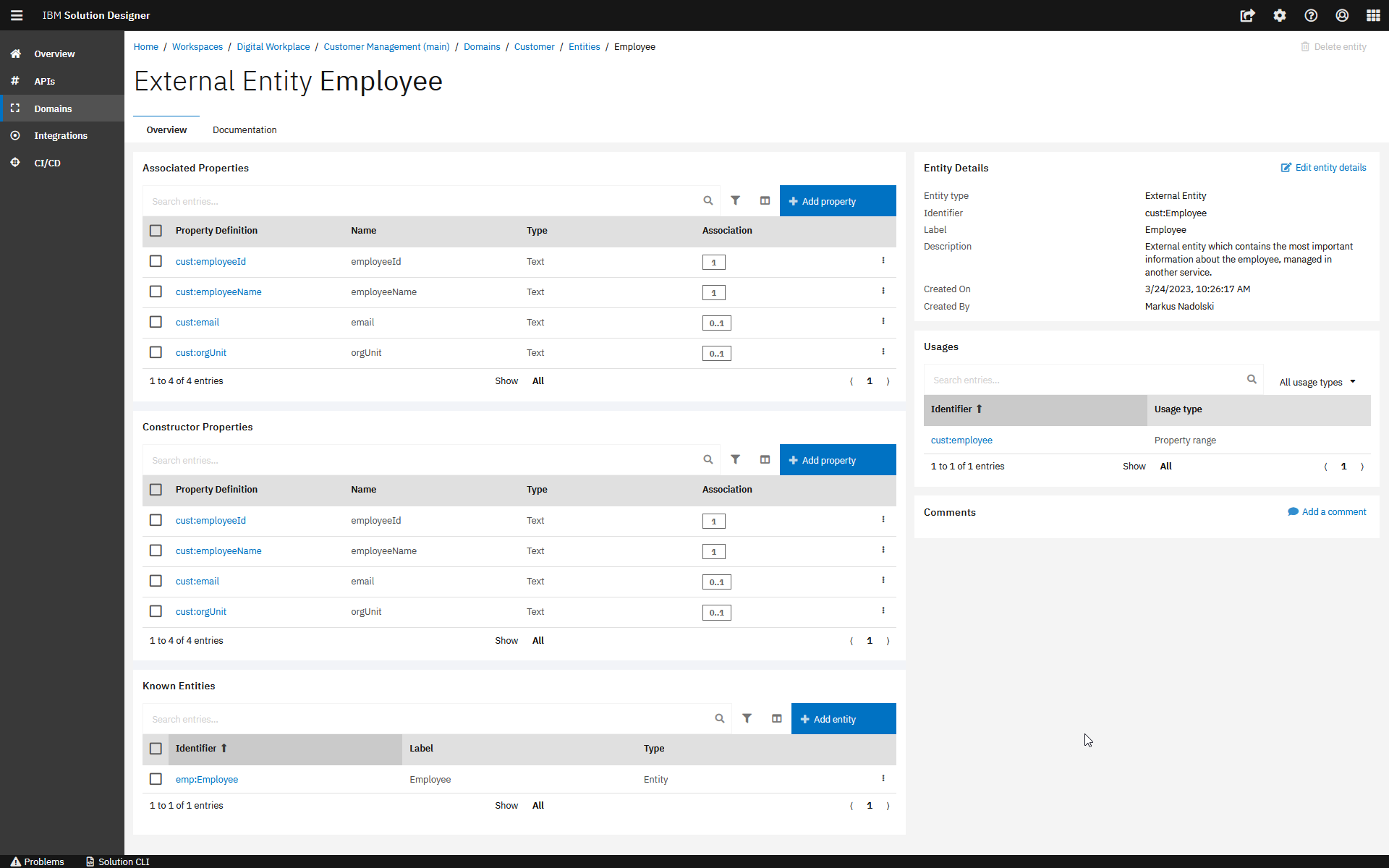
As you can see above, there are, compared to a (Root) Entity, additional sections for an External Entity. In the following we are describing the additional sections.
For more information, please refer to Product Documentation.
Constructor properties
Basically, the constructor properties are meant to be provided as input when an instance of an External Entity shall be created. In this sense it is comparable to an input entity of a Domain Service or a Command.
You should know that not in every case all properties must be added as Constructor Properties. It is dependent on the concrete use case or business requirement. So, you can either provide all properties in case you know that the input data can be trusted and is up-to-date. On the other hand, it is also possible to provide only one property, e.g. the employeeId, to be able to identify the Employee in the other service and then get the rest of properties from the external service (using an Integration Service).
Known Entities
An External Entity is supposed to be mapped to at least one Entity in the other service. Usually, the integration into the service happens in the Integration layer using a dedicated Integration Service, which is supposed to provide an Entity as output. In any Integration Namespace, an Entity can be added as Known Entity.
- Only in the section Entities of an Integration namespace, modelled Entities can serve as Known Entities. It is not possible for Integration Services created to be modelled as private output entities.
- You also need to know that the code generation for the Load method of an External Entity happens only when a Known Entity is added.
Implementing the logic for an External Entity
In the following, we will show you how to implement the logic for an External Entity. Depending on the design in the Solution Designer, the corresponding code files will be generated within an "externals" folder within the respective aggregate:
- An implementation file for each External Entity, e.g. Employee.ts, which contains three generated methods (Construct, Load, Validate), which can be executed for an External Entity instance
- A test file, e.g. Employee.test.ts
In the following, we will cover each implementation method. Please see also the Product Documentation for further information.
- TypeScript
- Java
Constructor method
The Constructor method is used to construct a local instance of the External Entity and to fill the associated properties with values for the construction defined properties. As code sample, you'll find below the Constructor method from the External Entity Employee in the Customer service:
export class Constructor extends entityConstructors.cust_EmployeeConstructor {
  /**
   * constructor method of external entity reference
   */
  public async create(): Promise<void> {
    const log = this.util.log;
    log.debug('Constructor.execute()');

    // Map input to Employee instance;
    this.instance.employeeId = this.input.employeeId;
    this.instance.employeeName = this.input.employeeName;
    this.instance.email = this.input.email;
    this.instance.orgUnit = this.input.orgUnit;
  }
}
The constructor method above takes all values from the input. If an initial check is required to see if the employee exists, or if only the property required for identification (employeeId) is to be provided in the input, the matching integration service must first be called to collect the required values.
Load method
The Load method is meant to load the Entity from the external service. Usually this happens by calling an Integration Service in the matching Integration Namespace.
It is intended that the Load returns undefined if the Integration Service has not found an Entity. In this case the Integration Service is supposed to throw a BusinessError, like EmployeeNotFound.
- It is necessary to overwrite the generated code
public async load(): Promise<void>by changing the Promise to the Entity you want to respond as output. For a sample see the code snippet below. - After calling the Integration Service, it is important to check whether the output exists. If this check does not occur, it is not possible to access the properties of the returned object. This is to prevent accessing properties that may not exist. This check is necessary for calling functions that are built to return two different types such as services that return either void or their output entity.
The code snippet below shows the implementation for the Load method of our example.
Looking at the code snippet, you will notice that the implemented Load method does not only return the values of the External Entity but the whole set of information the Integration Service provides. This is desired to provide all available information from the other service.
export class Load extends entityLoaders.cust_EmployeeLoader  {
  /**
   * load method of external entity reference - loads external entity from external system
   */
  // public async load(): Promise<void> {
  public async load(): Promise<emp_Employee> {
    const log = this.util.log;
    log.debug('Load.execute()');
    // Creating input for GetEmployee integration service
    const input = this.factory.entity.emp.GetEmployee_Input();
    // Setting employeeId from Employee instance
    input.employeeId = this.instance.employeeId;

    try {
      const serviceOutput = await this.services.emp.GetEmployee(input);
      if(!serviceOutput) {
        return;
      }

      // Create instance of emp:Employee and set values from integration service output
      const employee: emp_Employee = this.factory.entity.emp.Employee();
      employee.employeeId = serviceOutput.employeeId;
      employee.email = serviceOutput.email;
      employee.function = serviceOutput.function;
      employee.orgUnit = serviceOutput.orgUnit;
      employee.status = serviceOutput.status;
      employee.validFrom = serviceOutput.validFrom;
      employee.notes = serviceOutput.notes;
      employee.validUntil = serviceOutput.validUntil;

      // Create instance of emp:Person and set values
      const person: emp_Person = this.factory.entity.emp.Person();
      person.birthDay = serviceOutput.person.birthDay;
      person.partyId = serviceOutput.person.partyId;
      person.partyName = serviceOutput.person.partyName;
      person.city = serviceOutput.person.city;
      person.gender = serviceOutput.person.gender;

      // Set person for Employee
      employee.person = person;
      // Return Employee
      return employee;
    }
    catch (e) {
      if (this.isInstanceOf.businessError.emp.EmployeeNotFound(e)) {
        log.debug('Employee not found business error caught.');
        // When employee wasn't found (404) no return object is expected from Load().
        return undefined;
      }
      else {
        // When something else went wrong thrown a GeneralError which can be interpreted differently by caller
        log.debug('Loading Employee went wrong.');
        const message = "Couldn't load Employee due to unknown reasons.";
        const code = 'Employee not loaded.';
        throw new GeneralError(message, code);
      }
    }
  }
}
Validate method
The Validate method is intended to verify the existence of the Entity that matches the External Entity. Therefore, the Validate method calls the Load method, and depending on the output (either an output will be provided or not), the Validate returns either true or false. If an update of the External Entity shall be performed, the Validate must be called with the boolean update = true.
In case an error from the Load method was caught, also the Validate method should throw an error to be able to distinguish between the validation result false (Entity does not exist any more in the external service) or something else went wrong.
export class Validate extends entityValidators.cust_EmployeeValidator {
  /**
   * validate method of external entity reference - checks if external entity still exists in external system
   * @param update indicates whether local properties should be updated after validating entity on external system
   * @returns boolean indicating whether external entity still exists in external system
   */
  public async validate(update: boolean): Promise<boolean> {
    const log = this.util.log;
    log.debug('Validate.execute()');
    try {
    // Load Employee
      const loadOutput: emp_Employee = await this.instance.load();
      if (!loadOutput) {
        return false; // Validation failed!
      }
      else {
        if (update === true) {
          // When update = true, update Employee with output from Load
          // Note that employeeId should not change (therefore no update needed)
          this.instance.employeeName = loadOutput.person.partyName;
          this.instance.email = loadOutput.email;
          this.instance.orgUnit = loadOutput.orgUnit;
        }
        return true; // Validation suceeded!
      }
    }
    catch (e) {
      if (this.isInstanceOf.error.GeneralError(e)) {
        const code = 'ValidationNotPerformed';
        const message = 'Validation could not be performed because of an error.';
        const detailMessage = 'Validation of cust:Employee failed because of an unexpected error.';
        throw new GeneralError(message, detailMessage, code);
      }
    }
  }
}
Testing external entity implementation
As any other business relevant code, it is recommended to test your External Entity implementation. Below, you will find some examples how to test it.
Please consider that integration tests (using the generated test files) will be probably not enough for External Entities. The Reason is that it is not possible to mock the results from the Integration Service as well as the output of the Load method. So the tests would rely on having the external service running and the existence of the instance you would expect to exist for testing.
Integration tests
For the integration test of each External Entity, a test file (*.test.ts) will be generated. Below, an example for testing the Constructor method is shown.
For testing the Load and Validate methods, writing unit tests instead of integration tests is recommended to avoid to be dependent on an external service and the existence of a certain test instance.
describe('create', () => {
it('works', async () => {
  const runner = new externalEntityRunners.cust_EmployeeConstructorRunner();
  // Factory Constructor Input Entity
  runner.constructorInputEntity =  testEnvironment.factory.entity.cust.Employee_ConstInput();
  // Set values for constructor input
  runner.constructorInputEntity.employeeId = 'E000000001';
  runner.constructorInputEntity.employeeName = 'Max Employee';
  runner.constructorInputEntity.email = 'max.employee@email.de';
  runner.constructorInputEntity.orgUnit = 'Sales';
  // Employee instance must be explicitily created
  runner.entityInstance = await testEnvironment.factory.external.cust.Employee(runner.constructorInputEntity);
  // Trigger test runner
  await runner.run();
  // Check results
  expect(runner.output.employeeId).to.equal(runner.constructorInputEntity.employeeId);
  expect(runner.output.employeeName).to.equal(runner.constructorInputEntity.employeeName);
  expect(runner.output.email).to.equal(runner.constructorInputEntity.email);
  expect(runner.output.orgUnit).to.equal(runner.constructorInputEntity.orgUnit);
});
});
Unit tests
For unit testing, no stub files are generated. Before starting to write unit tests for your implementation, please have a look into the how-to Define Unit Tests (Typescript). There, the general concept of unit testing your Domain Service projects is described.
Below, you will find the concrete unit test example divided into several steps and test cases.
Import dependencies
Import the required dependencies such as the entities, TestEnvironment, Context and the external entity methods, which need to be tested. Also import the sinon dependencies, the expect function, the ServiceTrigger, the GeneralError and the entity, which is used as output of the integration service.
// Importing needed classes and interfaces from solution framework
import { Context, DebugRequestContext, externals, loadAndPrepareDebugConfig, TestEnvironment} from 'solution-framework';

// Importing needed chai and ts-sion
import { expect } from 'chai';
import sinon , {StubbedInstance, stubObject} from 'ts-sinon';

// Importing the implementation classes
import { Load as LoadBase } from './Employee';
import { Validate as ValidateBase } from './Employee';

// Importing service trigger class that we want to mock
import { ServiceTrigger } from 'solution-framework/dist/sdk/v1/solution/service/ServiceTrigger';

// Importing as output used entity and GeneralError
import { emp_Employee } from 'solution-framework/dist/sdk/v1/namespace/entity/emp_Employee';
import { GeneralError } from 'solution-framework/dist/sdk/v1/error/GeneralError';
Testing Load method - Declare variables and create test instance
For testing the Load method, it is necessary to mock the Integration Service GetEmployee. Additionally, a test instance of the External Entity must be created to be able to run the Load method on it.
describe('cust:Employee_Load', () => {
  // As service classes are protected, we need to extend it and use it in our tests
  class Load extends LoadBase {
    constructor(instance: externals.cust_Employee, requestContext: Context) {
      super(instance, requestContext);
    }
  }
  // Declare mock
  let employeeIntegrationServiceOutput: emp_Employee;

  // Declare service instance
  let employeeLoadInstance: Load;

  // Declare ext. entity Instance
  let extEmployeeInstance: externals.cust_Employee;

  // Declare serviceTriggerStubHelper stub for mocking ServiceTrigger
  let serviceTriggerStubHelper: StubbedInstance<ServiceTrigger>;

  // Create instance of test environment that provides access to factory to create new entity instances
  const testEnvironment = new TestEnvironment();

  before(async () => {
    // Load needed request context
    const requestContext = loadAndPrepareDebugConfig().requestContext;

    // Create constructor input
    const constructorInput = testEnvironment.factory.entity.cust.Employee_ConstInput();
    constructorInput.employeeId = 'E00000001';
    constructorInput.email = 'email@test.de';
    constructorInput.employeeName = 'Mary Smith';
    constructorInput.orgUnit = 'OrgUnit';

    // Create external Employee instance
    extEmployeeInstance = await testEnvironment.factory.external.cust.Employee(constructorInput);

    // Create a service instance that we will test
    // Notice that it needs the domain Json data and not the input object) => inputInstance['_getDomainJSON']()
    employeeLoadInstance = new Load(extEmployeeInstance, requestContext);

    // Mock the service trigger
    serviceTriggerStubHelper = stubObject<ServiceTrigger>(employeeLoadInstance.services);

    // Define expected output from integration service
    employeeIntegrationServiceOutput = testEnvironment.factory.entity.emp.Employee();
    const person = testEnvironment.factory.entity.emp.Person();
    person.birthDay = new Date(1970,5,6);
    person.city = 'Regensburg';
    person.gender = 'FEMALE';
    person.partyId = 'P000000001';
    person.partyName= 'Mary Smith';
    employeeIntegrationServiceOutput.person = person;
    employeeIntegrationServiceOutput.employeeId = 'E00000001';
    employeeIntegrationServiceOutput.status = 'ACTIVE';
    employeeIntegrationServiceOutput.function = 'Function';
    employeeIntegrationServiceOutput.orgUnit = 'OrgUnit';
    employeeIntegrationServiceOutput.notes = 'Notes';
    employeeIntegrationServiceOutput.validFrom = new Date();
  });

  after(async () => {
    // Remove all instances that were created
    await testEnvironment.cleanup();
    sinon.restore();
  });

  //
  // Below the test cases are described
  //

});
Load - Successful Load
To test whether the Load method was executed successfully, the result of the Load must be compared to the Integration Service (GetEmployee) mocked output.
Please note that the following code must be placed within the 'describe block' as commented in the code snippet above. Same applies for the following test cases.
it('Load works - Employee loaded', async () => {
    // Create a mocked service function to replace the one in the serviceTriggerStubHelper
    const mockedGetEmployeeService = sinon.fake(() => {
      return employeeIntegrationServiceOutput;
    });
    // Replace the stub function with the mocked function
    serviceTriggerStubHelper.emp.GetEmployee = mockedGetEmployeeService;

    // Call load method
    const resultLoad: emp_Employee = await employeeLoadInstance.load();

    // Checking result of Load
    sinon.assert.calledOnce(mockedGetEmployeeService);
    expect (resultLoad.employeeId).to.equal(employeeIntegrationServiceOutput.employeeId);
    expect (resultLoad.email).to.equal(employeeIntegrationServiceOutput.email);
    expect (resultLoad.function).to.equal(employeeIntegrationServiceOutput.function);
    expect (resultLoad.orgUnit).to.equal(employeeIntegrationServiceOutput.orgUnit);
    expect (resultLoad.notes).to.equal(employeeIntegrationServiceOutput.notes);
    expect (resultLoad.status).to.equal(employeeIntegrationServiceOutput.status);
    expect (resultLoad.validFrom).to.equal(employeeIntegrationServiceOutput.validFrom);
    expect (resultLoad.validUntil).to.equal(employeeIntegrationServiceOutput.validUntil);
    expect (resultLoad.person.birthDay).to.equal(employeeIntegrationServiceOutput.person.birthDay);
    expect (resultLoad.person.city).to.equal(employeeIntegrationServiceOutput.person.city);
    expect (resultLoad.person.gender).to.equal(employeeIntegrationServiceOutput.person.gender);
    expect (resultLoad.person.partyId).to.equal(employeeIntegrationServiceOutput.person.partyId);
    expect (resultLoad.person.partyName).to.equal(employeeIntegrationServiceOutput.person.partyName);
  });
Load - Employee not found
To test the case that the Integration service throws a "Not-Found-Business Error", you would need to mock this Business Error, which is unfortunately not possible. Nevertheless, to test this roughly you could do it as in the code snippet below described. To follow this approach you need to throw a GeneralError (instead of the Business Error) in the test case. Additionally, you need (only for running the test) to change the implementation to not check for the type of caught error (and then to return undefined).
Please be aware that the described approach is only a crutch for testing the "Not found" case. It does not allow to test this scenario in its entirety. If you do it in this way, please make sure to make the adjustments in the implementation class undone after testing.
 it('Load: employee not found - *** Needs manual adjustments to run this test case ***', async () => {
    // *************************************** IMPORTANT NOTE FOR TEST EXECUTION ***************************************
    // In this (test) case it is a necessary precondition that the GetEmployee integration service throws a BusinessError emp:EmployeeNotFound!
    // Since it is not possible to throw such an error in the test, a GeneralError will be thrown in this test instead.
    // To finish this test case successfully, an adjustment in the Employee.ts implementation file is necessary.
    // The following check for the BusinessError needs to get disabled: "if (this.isInstanceOf.businessError.emp.EmployeeNotFound(e))" (in line 78),
    // so that the in this case expected behaviour to return undefined can be tested. Please be aware to enable checking the type of error again,
    // after running the unit test. Because without manipulating the implementation the test won't run successfully, this test case
    // implementation is commented out by default.

    /*
    // Create a mocked service function to replace the one in the serviceTriggerStubHelper
    const mockedGetEmployeeService = sinon.fake(() => {
      throw new GeneralError('Employee not found', 'Employee with the provided employee id was not found.', 'emp:EmployeeNotFound');
    });

    // Replace the stub function with the mocked function
    serviceTriggerStubHelper.emp.GetEmployee = mockedGetEmployeeService;

    // Call load method
    const resultLoad: emp_Employee = await employeeLoadInstance.load();

    // Checking result of Load
    sinon.assert.calledOnce(mockedGetEmployeeService);
    expect (resultLoad).to.equal(undefined); // When the Load receives the BusinessError emp:EmployeeNotFound, it is expected to get no output (undefined)
    */
  });
Testing Employee_Validate - Declare variables and create test instance
For testing the Validate method, it is necessary to mock the Load method. Additionally, a test instance of the External Entity must be created to be able to run the Validate method on it.
describe('cust:Employee_Validate', () => {

  let requestContext: DebugRequestContext;

  // As service classes are protected, we need to extend it and use it in our tests
  class Validate extends ValidateBase {
    // eslint-disable-next-line no-shadow
    constructor(instance: externals.cust_Employee, requestContext: Context) {
      super(instance, requestContext);
    }
  }
  // Declare mock
  let loadedEmployee: emp_Employee;

  // Declare service instance
  let employeeValidateInstance: Validate;

  // Declare ext. entity Instance
  let extEmployeeInstance: externals.cust_Employee;

  // Create instance of test environment that provides access to factory to create new entity instances
  const testEnvironment = new TestEnvironment();

  beforeEach(async () => {
    // Load needed request context
    requestContext = loadAndPrepareDebugConfig().requestContext;

    // Create constructor input
    const constructorInput = testEnvironment.factory.entity.cust.Employee_ConstInput();
    constructorInput.employeeId = 'E00000001';
    constructorInput.email = 'email@test.de';
    constructorInput.employeeName = 'Mary Smith';
    constructorInput.orgUnit = 'OrgUnit';

    // Create external Employee instance
    extEmployeeInstance = await testEnvironment.factory.external.cust.Employee(constructorInput);

    // Define expected output from Load
    loadedEmployee = testEnvironment.factory.entity.emp.Employee();
    loadedEmployee.person = testEnvironment.factory.entity.emp.Person();
    loadedEmployee.email = 'email_updated@test.de';
    loadedEmployee.person.birthDay = new Date(1970,5,6);
    loadedEmployee.person.city = 'Regensburg';
    loadedEmployee.person.gender = 'FEMALE';
    loadedEmployee.person.partyId = 'P000000001';
    loadedEmployee.person.partyName= 'Mary Smith-Forest';
    loadedEmployee.employeeId = 'E00000001';
    loadedEmployee.status = 'ACTIVE';
    loadedEmployee.function = 'Function';
    loadedEmployee.orgUnit = 'OrgUnit2';
    loadedEmployee.notes = 'Notes';
    loadedEmployee.validFrom = new Date();
  });

  after(async () => {
    // Recommended: remove all instances that were created
    await testEnvironment.cleanup();
    sinon.restore();
  });

  //
  // Below the test cases are described
  //

});
Validate - Validation result = true and update peformed
Depending on the parameter update, the Validate method shall update the External Entity or not. This test case checks the validation and whether the update was performed as expected. Therefore, it will be tested if the External Entity was updated with the values from the Load.
it('Validate works - update performed', async () => {

	// Create a service instance that we will test
	// Notice that it needs the domain Json data and not the input object) => inputInstance['_getDomainJSON']()
	employeeValidateInstance = new Validate(extEmployeeInstance, requestContext);
	const mockedEmployeeLoad =  sinon.fake(()=> {
	  return loadedEmployee;
	});

	employeeValidateInstance.instance.load = mockedEmployeeLoad;

	// Call validate method
	const validateResult: boolean = await employeeValidateInstance.validate(true);
	// Checking result
	sinon.assert.calledOnce(mockedEmployeeLoad);
	expect(validateResult).to.equal(true);
	expect(extEmployeeInstance.email).to.equal(loadedEmployee.email);
	expect(extEmployeeInstance.employeeId).to.equal(loadedEmployee.employeeId);
	expect(extEmployeeInstance.employeeName).to.equal(loadedEmployee.person.partyName);
	expect(extEmployeeInstance.orgUnit).to.equal(loadedEmployee.orgUnit);
  });
Validate - Validation result = true but no update desired
This test case checks the validation. To ensure that the External Entity is not modified, the test verifies whether the instance has not been modified.
  it('Validate works - no update performed', async () => {

    // Create a service instance that we will test
    // Notice that it needs the domain Json data and not the input object) => inputInstance['_getDomainJSON']()
    employeeValidateInstance = new Validate(extEmployeeInstance, requestContext);
    const mockedEmployeeLoad =  sinon.fake(()=> {
      return loadedEmployee;
    });

    employeeValidateInstance.instance.load = mockedEmployeeLoad;

    // Call validate method
    const validateResult: boolean = await employeeValidateInstance.validate(false);

    // Checking result
    sinon.assert.calledOnce(mockedEmployeeLoad);
    expect(validateResult).to.equal(true);
    expect(extEmployeeInstance.email).to.not.equal(loadedEmployee.email);
    expect(extEmployeeInstance.employeeId).to.equal(loadedEmployee.employeeId);
    expect(extEmployeeInstance.employeeName).not.to.equal(loadedEmployee.person.partyName);
    expect(extEmployeeInstance.orgUnit).to.not.equal(loadedEmployee.orgUnit);
  });
Validate - Validation result = false
Again, the Validation method shall be checked, but in this case it is expected that the validation result is false. To prove this, the result of the Load got mocked to return undefined.
  it('Validate - validation worked but failed because Employee could not get loaded', async () => {

    // Create a service instance that we will test
    // Notice that it needs the domain Json data and not the input object) => inputInstance['_getDomainJSON']()
    employeeValidateInstance = new Validate(extEmployeeInstance, requestContext);
    const mockedEmployeeLoad =  sinon.fake(()=> {
      return undefined;
    });

    employeeValidateInstance.instance.load = mockedEmployeeLoad;

    // Call validate method
    const validateResult: boolean = await employeeValidateInstance.validate(false);

    // Checking result
    sinon.assert.calledOnce(mockedEmployeeLoad);
    expect(validateResult).to.equal(false);
  });
Validate - Validation not performed with error
Finally, it is checked whether an error (not of the type Business Error "Not found") hinders validation. Therefore, the Load is mocked to throw a General Error.
  it('Validate was not performed - error occured', async () => {

    // Create a service instance that we will test
    // Notice that it needs the domain Json data and not the input object) => inputInstance['_getDomainJSON']()
    employeeValidateInstance = new Validate(extEmployeeInstance, requestContext);
    const message = "Couldn't load Employee due to unknown reasons.";
    const code = 'Employee not loaded.';

    const mockedEmployeeLoad =  sinon.fake.throws(new GeneralError(code, message));

    employeeValidateInstance.instance.load = mockedEmployeeLoad;
    try {
      // Call validate method
      // eslint-disable-next-line @typescript-eslint/no-unused-vars
      const validateResult: boolean = await employeeValidateInstance.validate(false);
    }
    catch (e) {
      // Checking result
      sinon.assert.calledOnce(mockedEmployeeLoad);
      expect(e.code).to.equal('ValidationNotPerformed');
      expect(e.message).to.equal('Validation could not be performed because of an error.');
      expect(e.detailMessage).to.equal('Validation of cust:Employee failed because of an unexpected error.');
    }
  });
package de.k5.minutes.minutes.domain.mnts.external;

import java.util.Optional;
import org.springframework.stereotype.Service;

import de.k5.minutes.minutes.sdk.domain.mnts.external.Employee;
import de.k5.minutes.minutes.sdk.domain.mnts.external.EmployeeServiceBase;
import de.k5.minutes.minutes.sdk.integration.emp.entity.GetEmployeeInput;
import de.k5.minutes.minutes.sdk.integration.emp.entity.GetEmployeeInputEntity;
import de.k5.minutes.minutes.sdk.integration.emp.error.EmployeeNotFound;
import de.k5.minutes.minutes.integration.emp.service.GetEmployee;
import de.k5.minutes.minutes.sdk.domain.facade.DomainEntityBuilder;
import de.k5.minutes.minutes.sdk.domain.facade.Repository;
import org.slf4j.Logger;
import org.slf4j.LoggerFactory;

@Service
public class EmployeeService extends EmployeeServiceBase {

  private static final Logger log = LoggerFactory.getLogger(EmployeeService.class);
  private GetEmployee getEmployeeIntegrationService;

  public EmployeeService(DomainEntityBuilder entityBuilder, Repository repo, GetEmployee getEmployeeIntegrationService){
    super(entityBuilder,repo);
    this.getEmployeeIntegrationService = getEmployeeIntegrationService;
  }
}
Constructor method
The Constructor method is used to construct a local instance of the External Entity and to fill the associated properties with values for the construction defined properties. As code sample, you'll find below the Constructor method from the External Entity Employee in the Minutes service:
  /**
   * constructor method of external entity reference
   */
  @Override
public Employee create(String employeeId, String employeeName, String orgUnit) {

  log.info("EmployeeService.create()");

  return new Employee(employeeId, employeeName, orgUnit);
}
The constructor method above takes all values from the input. If an initial check is required to see if the employee exists, or if only the property required for identification (employeeId) is to be provided in the input, the matching integration service must first be called to collect the required values.
Load method
The Load method is meant to load the Entity from the external service. Usually this happens by calling an Integration Service in the matching Integration Namespace.
It is intended that the Load returns null if the Integration Service has not found an Entity. In this case the Integration Service is supposed to throw a BusinessError, like EmployeeNotFound.
- In java, it is necessary to overwrite the generated code of this method
public k5.sdk.springboot.mongodb.entity.Entity load(de.k5.minutes.minutes.sdk.domain.mnts.external.Employee externalEntity);by changing the Promise to the Entity you want to respond as output. For a sample see the code snippet below. - After calling the Integration Service, it is important to check whether the output exists. If this check does not occur, it is not possible to access the properties of the returned object. This is to prevent accessing properties that may not exist. This check is necessary for calling functions that are built to return two different types such as services that return either void or their output entity.
The code snippet below shows the implementation for the Load method of our example.
Looking at the code snippet, you will notice that the implemented Load method does not only return the values of the External Entity but the whole set of information the Integration Service provides. This is desired to provide all available information from the other service.
/**
  * Load external Entity and return as an Entity
  *
  * @param externalEntity instance of Employee
  * @return class that extends base type Entity
  */
@Override
public de.k5.minutes.minutes.sdk.integration.emp.entity.Employee load(Employee externalEntity) {

  log.info("EmployeeService.load()");

  try {
    GetEmployeeInput getEmployeeInput = new GetEmployeeInputEntity();
    getEmployeeInput.setEmployeeId(externalEntity.getEmployeeId());

    return getEmployeeIntegrationService.execute(getEmployeeInput);
  }
  catch(EmployeeNotFound e) {
    return null;
  }
}
Validate method
The Validate method is intended to verify the existence of the Entity that matches the External Entity. Therefore, the Validate method calls the Load method, and depending on the output (either an output will be provided or not), the Validate returns an Optional-object which is either present (=contains an External Entity) or empty (=contains no External Entity). If an update of the External Entity shall be performed, the Validate must be called with the boolean update = true.
  /**
  * validate the existence of the external entity in the external system.
  *
  * @param externalEntity instance of Employee.
  * @param update          flag to indicate whether should an updated
  *                        Employee instance be created and
  *                        returned or not.
  * @return Optional Employee instance to indicate whether
  *         external entity still exists in external system
  */
@Override
public Optional<Employee> validate(Employee externalEntity, boolean update) {

  log.info("EmployeeService.validate()");

  try {
    GetEmployeeInput getEmployeeInput = new GetEmployeeInputEntity();
    getEmployeeInput.setEmployeeId(externalEntity.getEmployeeId());

    de.k5.minutes.minutes.sdk.integration.emp.entity.Employee employeeIntegrationEntity =
      getEmployeeIntegrationService.execute(getEmployeeInput);

    if(update) {
      externalEntity.setEmployeeName(employeeIntegrationEntity.getPerson().getPartyName());
      externalEntity.setOrgUnit(employeeIntegrationEntity.getOrgUnit());
    }

    return Optional.of(externalEntity);
  }
  catch(EmployeeNotFound e) {
    return Optional.empty();
  }
}
Testing external entity implementation
As any other business relevant code, it is recommended to test your External Entity implementation. Below, you will find some examples how to test it.
Unit tests
For unit testing, no stub files are generated. Before starting to write unit tests for your implementation, please have a look into the how-to Define Unit Tests (Java). There, the general concept of unit testing your Domain Service projects is described.
Below, you will find the concrete unit test example divided into several steps and test cases.
Import dependencies
Import the required dependencies such as the entities, TestEnvironment, Context and the external entity methods, which need to be tested. Also import the sinon dependencies, the expect function, the ServiceTrigger, the GeneralError and the entity, which is used as output of the integration service.
package domain.external;

import java.time.LocalDate;
import java.time.OffsetDateTime;
import java.util.Optional;

import de.k5.minutes.minutes.sdk.domain.mnts.repository.NotesNumbersRepository;
import org.assertj.core.api.Assertions;
import org.junit.jupiter.api.BeforeEach;
import org.junit.jupiter.api.Test;
import org.mockito.BDDMockito;
import org.mockito.invocation.InvocationOnMock;
import org.springframework.http.HttpHeaders;
import org.springframework.http.HttpStatus;
import org.springframework.http.ResponseEntity;

import de.k5.minutes.minutes.domain.mnts.external.EmployeeService;
import de.k5.minutes.minutes.integration.emp.service.GetEmployee;
import de.k5.minutes.minutes.sdk.domain.facade.DomainEntityBuilder;
import de.k5.minutes.minutes.sdk.domain.facade.Repository;
import de.k5.minutes.minutes.sdk.domain.mnts.external.Employee;
import de.k5.minutes.minutes.sdk.domain.mnts.facade.MntsEntityBuilder;
import de.k5.minutes.minutes.sdk.domain.mnts.facade.MntsRepository;
import de.k5.minutes.minutes.sdk.domain.mnts.repository.MinutesRepository;
import de.k5.minutes.minutes.sdk.domain.mnts.repository.NotesRepository;
import de.k5.minutes.minutes.sdk.integration.cust.facade.CustEntityBuilder;
import de.k5.minutes.minutes.sdk.integration.emp.employee.model.Person.GenderEnum;
import de.k5.minutes.minutes.sdk.integration.emp.employee.provider.EmployeesApiEmployee;
import de.k5.minutes.minutes.sdk.integration.emp.facade.EmpEntityBuilder;
import de.k5.minutes.minutes.sdk.integration.facade.IntegrationEntityBuilder;
Testing Load method - Declare variables and create test instance
For testing the Load method, it is necessary to mock the Integration Service GetEmployee. Additionally, a test instance of the External Entity must be created to be able to run the Load method on it.
public class EmployeeServiceTest {
  private EmployeeService employeeExternalEntityService;
  private GetEmployee getEmployeeService;

  private CustEntityBuilder custEntityBuilder;
  private EmpEntityBuilder empEntityBuilder;
  private IntegrationEntityBuilder integrationEntityBuilder;

  private Repository repo;
  private NotesRepository notesRepo;
  private MinutesRepository minutesRepo;
  private NotesNumbersRepository notesNumbersRepo;

  private DomainEntityBuilder entityBuilder;

  private EmployeesApiEmployee employeesApiEmployee;
  private de.k5.minutes.minutes.sdk.integration.emp.employee.model.Employee mockedEmployeeSchema;

  private String testEmployeeId;
  private String testEmployeeName;
  private String testOrgUnit;


  /**
   * This setUp runs before every unit test, providing us with the main entity which will be used by
   * the unit tests.
   *
   */
  @BeforeEach
  public void setUp() {
    // Mock repositories
    notesRepo = BDDMockito.mock(NotesRepository.class);
    minutesRepo = BDDMockito.mock(MinutesRepository.class);
    notesNumbersRepo = BDDMockito.mock(NotesNumbersRepository.class);
    repo = new Repository(new MntsRepository(minutesRepo, notesRepo,notesNumbersRepo));

    // Create entity builders
    custEntityBuilder = new CustEntityBuilder();
    empEntityBuilder = new EmpEntityBuilder();
    integrationEntityBuilder = new IntegrationEntityBuilder(custEntityBuilder, empEntityBuilder);

    MntsEntityBuilder mntsEntityBuilder = new MntsEntityBuilder();
    entityBuilder = new DomainEntityBuilder(mntsEntityBuilder);

    // Create integration service
    employeesApiEmployee = BDDMockito.mock(EmployeesApiEmployee.class);
    getEmployeeService = new GetEmployee(integrationEntityBuilder, employeesApiEmployee);

    // Create external entity service
    employeeExternalEntityService = new EmployeeService(entityBuilder, repo, getEmployeeService);

    // Create mocked person schema
    de.k5.minutes.minutes.sdk.integration.emp.employee.model.Person mockedPersonSchema = new de.k5.minutes.minutes.sdk.integration.emp.employee.model.Person();
    mockedPersonSchema.setPartyId(String.format("%09d", 2));
    mockedPersonSchema.setPartyName("Maria Musterfrau");
    mockedPersonSchema.setCity("Regensburg");
    mockedPersonSchema.setBirthDay(LocalDate.of(1975, 1, 1));
    mockedPersonSchema.setGender(GenderEnum.FEMALE);

    // Create mocked employee schema
    testEmployeeId = String.format("%09d", 1);
    testEmployeeName = mockedPersonSchema.getPartyName();
    testOrgUnit = "Backend";
    mockedEmployeeSchema = new de.k5.minutes.minutes.sdk.integration.emp.employee.model.Employee();
    mockedEmployeeSchema.setEmployeeId(testEmployeeId);
    mockedEmployeeSchema.setEmail("maria.musterfrau@gmail.com");
    mockedEmployeeSchema.setFunction("Software engineer");
    mockedEmployeeSchema.setNotes("notes 1");
    mockedEmployeeSchema.setOrgUnit(testOrgUnit);
    mockedEmployeeSchema.setEmployeeStatus(de.k5.minutes.minutes.sdk.integration.emp.employee.model.Employee.EmployeeStatusEnum.ACTIVE);
    mockedEmployeeSchema.setValidFrom(OffsetDateTime.now().minusMonths(1));
    mockedEmployeeSchema.setValidUntil(OffsetDateTime.now());
    mockedEmployeeSchema.setPerson(mockedPersonSchema);

    // Configure function getEmployee of mocked employees api employee service
    BDDMockito.given(employeesApiEmployee.getEmployee(BDDMockito.anyString(), BDDMockito.any(HttpHeaders.class)))
      .will((InvocationOnMock invocation) -> {
        if(invocation.getArgument(0).equals(testEmployeeId)) {
          return new ResponseEntity<de.k5.minutes.minutes.sdk.integration.emp.employee.model.Employee>(mockedEmployeeSchema, HttpStatus.OK);
        }
        else {
          return new ResponseEntity<de.k5.minutes.minutes.sdk.integration.emp.employee.model.Employee>(HttpStatus.NOT_FOUND);
        }
      });
  }
}
Create
Here is an example of how to test the constructor method. Because the only step of this method is to assign the constructor input properties to the new created External Entities, only one test case is needed. If e.g. calling the load method, which may fail, is included in the constructor method, also the error cases have to be tested.
@Test
void create() {
  try {
    // Execute the external entity service
    Employee employeeExternalEntity = employeeExternalEntityService.create(testEmployeeId, testEmployeeName, testOrgUnit);

    // Validate the result
    Assertions.assertThat(employeeExternalEntity.getEmployeeId()).isEqualTo(mockedEmployeeSchema.getEmployeeId());
    Assertions.assertThat(employeeExternalEntity.getEmployeeName()).isEqualTo(mockedEmployeeSchema.getPerson().getPartyName());
    Assertions.assertThat(employeeExternalEntity.getOrgUnit()).isEqualTo(mockedEmployeeSchema.getOrgUnit());
  }
  catch(Exception e) {
    // Fail the test if an error is thrown
    Assertions.fail("Error should not be thrown", e);
  }
}
Load - Successful Load
To test whether the Load method was executed successfully, the result of the Load must be compared to the Integration Service (GetEmployee) mocked output.
Please note that the following code must be placed within the 'describe block' as commented in the code snippet above. Same applies for the following test cases.
@Test
void load() {
  try {
    // Prepare the input
    Employee employeeExternalEntity = new Employee(testEmployeeId, testEmployeeName, testOrgUnit);

    // Execute the external entity service
    de.k5.minutes.minutes.sdk.integration.emp.entity.Employee employeeIntegrationEntity = employeeExternalEntityService.load(employeeExternalEntity);

    // Validate the result
    Assertions.assertThat(employeeIntegrationEntity.getEmployeeId()).isEqualTo(mockedEmployeeSchema.getEmployeeId());
    Assertions.assertThat(employeeIntegrationEntity.getEmail()).isEqualTo(mockedEmployeeSchema.getEmail());
    Assertions.assertThat(employeeIntegrationEntity.getFunction()).isEqualTo(mockedEmployeeSchema.getFunction());
    Assertions.assertThat(employeeIntegrationEntity.getNotes()).isEqualTo(mockedEmployeeSchema.getNotes());
    Assertions.assertThat(employeeIntegrationEntity.getEmployeeStatus()).hasToString(mockedEmployeeSchema.getEmployeeStatus().getValue());
    Assertions.assertThat(employeeIntegrationEntity.getValidFrom()).isEqualTo(mockedEmployeeSchema.getValidFrom());
    Assertions.assertThat(employeeIntegrationEntity.getValidUntil()).isEqualTo(mockedEmployeeSchema.getValidUntil());
    Assertions.assertThat(employeeIntegrationEntity.getPerson().getPartyId()).isEqualTo(mockedEmployeeSchema.getPerson().getPartyId());
    Assertions.assertThat(employeeIntegrationEntity.getPerson().getPartyName()).isEqualTo(mockedEmployeeSchema.getPerson().getPartyName());
    Assertions.assertThat(employeeIntegrationEntity.getPerson().getBirthDay()).isEqualTo(mockedEmployeeSchema.getPerson().getBirthDay());
    Assertions.assertThat(employeeIntegrationEntity.getPerson().getCity()).isEqualTo(mockedEmployeeSchema.getPerson().getCity());
    Assertions.assertThat(employeeIntegrationEntity.getPerson().getGender()).hasToString(mockedEmployeeSchema.getPerson().getGender().toString());
  }
  catch(Exception e) {
    // Fail the test if an error is thrown
    Assertions.fail("Error should not be thrown", e);
  }
}
Load - Employee not found
Again, the Load method shall be checked, but in this case it is expected that the result is null. To prove this, the input for the Load method is modified so that the integration service throws a business error (EmployeeNotFound) when searching for employees.
 @Test
void load_EmployeeNotFound() {
  // Prepare the input
  Employee employeeExternalEntity = new Employee("9999", testEmployeeName, testOrgUnit);

  // Execute the external entity service
  de.k5.minutes.minutes.sdk.integration.emp.entity.Employee employeeIntegrationEntity = employeeExternalEntityService.load(employeeExternalEntity);

  // Validate the result
  Assertions.assertThat(employeeIntegrationEntity).isNull();
}
Testing Employee_Validate - Declare variables and create test instance
For testing the Validate method, it is necessary to mock the Load method. Additionally, a test instance of the External Entity must be created to be able to run the Validate method on it.
Validate - Validation result = present optional and update performed
Depending on the parameter update, the Validate method shall update the External Entity or not. This test case checks the validation and whether the update was performed as expected. Therefore, it will be tested if the External Entity was updated with the values from the Load.
@Test
void validate_Update() {
  try {
    // Prepare the input
    Employee employeeExternalEntity = new Employee(testEmployeeId, "Max Mustermann", "Frontend");
    boolean update = true;

    // Execute the external entity service
    Optional<Employee> optionalResultEmployeeExternalEntity = employeeExternalEntityService.validate(employeeExternalEntity, update);

    // Validate the result
    Assertions.assertThat(optionalResultEmployeeExternalEntity).isPresent();

    Assertions.assertThat(employeeExternalEntity.getEmployeeId()).isEqualTo(mockedEmployeeSchema.getEmployeeId());
    Assertions.assertThat(employeeExternalEntity.getEmployeeName()).isEqualTo(mockedEmployeeSchema.getPerson().getPartyName());
    Assertions.assertThat(employeeExternalEntity.getOrgUnit()).isEqualTo(mockedEmployeeSchema.getOrgUnit());
  }
  catch(Exception e) {
    // Fail the test if an error is thrown
    Assertions.fail("Error should not be thrown", e);
  }
}
Validate - Validation result = present optional but no update desired
This test case checks the validation. To ensure that the External Entity is not modified, the test verifies whether the instance has not been modified.
  @Test
void validate_NoUpdate() {
  try {
    // Prepare the input
    String testEmployeeName2 = "Max Mustermann";
    String testOrgUnit2 = "Frontend";
    Employee employeeExternalEntity = new Employee(testEmployeeId, testEmployeeName2, testOrgUnit2);
    boolean update = false;

    // Execute the external entity service
    Optional<Employee> optionalResultEmployeeExternalEntity = employeeExternalEntityService.validate(employeeExternalEntity, update);

    // Validate the result
    Assertions.assertThat(optionalResultEmployeeExternalEntity).isPresent();

    Assertions.assertThat(employeeExternalEntity.getEmployeeId()).isEqualTo(testEmployeeId);
    Assertions.assertThat(employeeExternalEntity.getEmployeeName()).isEqualTo(testEmployeeName2);
    Assertions.assertThat(employeeExternalEntity.getOrgUnit()).isEqualTo(testOrgUnit2);
  }
  catch(Exception e) {
    // Fail the test if an error is thrown
    Assertions.fail("Error should not be thrown", e);
  }
}
Validate - Employee not found
Again, the Validation method shall be checked, but in this case it is expected that the validation result is an empty Optional-object. To prove this, input for the Validation method is modified so that the Load method returns null.
  @Test
void validate_EmployeeNotFound() {
  // Prepare the input
  Employee employeeExternalEntity = new Employee("9999", testEmployeeId, testOrgUnit);
  boolean update = false;

  // Execute the external entity service
  Optional<Employee> optionalResultEmployeeExternalEntity = employeeExternalEntityService.validate(employeeExternalEntity, update);

  // Validate the result
  Assertions.assertThat(optionalResultEmployeeExternalEntity).isEmpty();
}
Conclusion
In this how-to you got an overview of the purpose of External Entities and how to model them in the Solution Designer. Furthermore, you were provided concrete examples of how to implement the logic for an External Entity and how to test it.